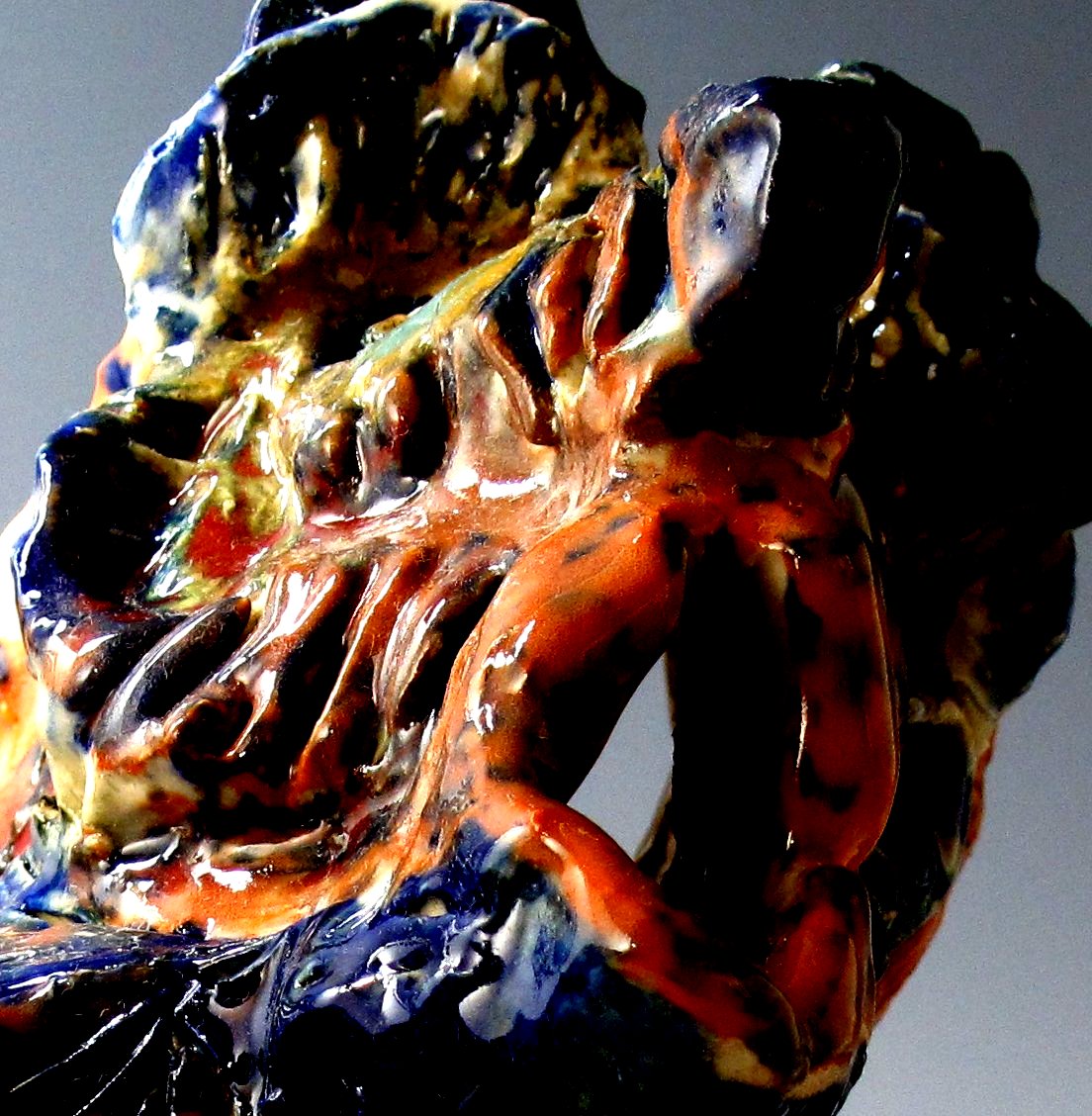
Friday, November 27, 2009

Dreaming Burrow


Beings attracted to piles of rock collect them in memory, berms of dirt, river silt with gold traces children climb, berms as high and river rock as smooth as basket balls to lift around. Not confined to time and place, sometimes a badger comes below the rosemary in the hill. Memories build the way sheep appear half way up the cliff rocks of Peralta Trail. Not like a hawk, a dog or cat, more like a groundhog or rat,  badger or fox feels the earth house. Comfortable in the walls of a body to meditate, store nuts, build entrances and exits, sharpen faculties, peace in the bairn. Texas Canyon, Enchanted Rock, Old Sarum, caer sites,  Cromlechs, berms, forts, burrows for all the manners and types of sleep. Badger works hard all day on the burrow. Mouse, Rat labor night and day, sleep not confined to one or the other, dreaming a burrow, dreams together no matter what the occupant, in the burrow meditation runs deep. Not that hawks don't brood at tree tops with arpeggios or cats brood with one eye to events. Sleep is a trail on a hill covered with trees, however faint. In the Mazatal draws and sides of rock cairns you can just see with the peripheral eye, I carried a son on my shoulders. Yellow Rattler, what are animal faculties? Yale professor Robert Shiller says Animal Spirits are a forecasting tool, that irrationality leads to wealth, but animal spirits involve 1) the reality of hunger, laying low 2) love the sun, love night and 3) sleep. So Bunyan says "poor silly Mole, that thou shouldst love to be, / Where thou, nor Sun, nor Moon, nor Stars can see." Poor Bunyan.
11/24, 63-2, 60-2

Saturday, August 15, 2009

Imagination of Kinship

This is the way earth lasts. Grandma rules. The present is subordinated to the past and reimagines the warp and woof of its family weaving. Family represents tribe, nation and world. Grandma Rules describe larger entities.

Pious anthropologists and linguists think to save a tribe's infrastructure, but it is only the business of the family/tribe. Arouse a lot of ire by suggesting that anthropologists study themselves and their own people. They do not have a people. They have peers everywhere undermined and lost as much among the Navajo and Hopi as the Pennsylvania Dutch.

I heard, "the imagination of kinship," echo spoken in the air a moment before waking. As a cue of Navajo matriarchy and kinship naming (2005), the words also occur in Karl Magnuson's, The World from Within, in "The Utopian Imagination of Aboriginalism," and in "Virtual Kinship, Real Estate, and Diaspora Formation" and are elaborated in the Poetics of the Feminine, an instance where the thing exists in a way not previously known, as is said of consciousness? This also recalls guest-host codes and a reverence of patriarchy. Kinship becomes an inquiry into mythogeme such as Bataille's death of myth and birth of anti-myth, also in Steve McCaffery's, Prior to meaning: the protosemantic and poetics (45) who applies Prigogine's physics to poetry. I heard Prigogine say that poetry and physics are one. McCaffery and Magnuson circle the one. Do you want to take Grandma off the machine? I bet you'd like to know what all this means. So would I.

Sunday, August 2, 2009

Chimeric Splicing and the Bestiaries

The man transferred to earth attitudes of domination and control he applied to woman. It still begs the question whether if he feels this of woman and earth, he feels it of himself. This creature must give or have given an account of himself to understand why we are in the middle of a mass extinction. Because we can lions are poisoned in Kenya with pesticide used in their murder. We can fuel the technology of destructive urges at every turn, scientists loose bees, nurserymen ship ants, exhausts of every combustion. But technology is not the cause, if the means. We explore these causes below.

Blake's portrayal of animals, like the bestiaries, pictures the negative states of a man as an antinomian of creation, a heresy compared with Psalms and Job. Don't be like the tiger. Do be like the ant. Each species as a morality play is not a thing in itself of wonder. This attitude translates into science. What use is the thing, what experiments can be run, will it make a good paper, improve human lot? Not. This morality play will be running with polar ice. Songbirds are good, hawks are bad. There is a cliched pattern of English folklore.

If we take a premise that poets were writing of the coming extinction even when industry revolted and have been in increasing numbers since, then many celebrations of the natural are done prophetically. This prophetic capacity in the negative man preoccupies his own works.That is where we awake to peer deeply into psyche to determine the cause.

If William Blake was the first to celebrate the human toll of industrialization in his chimney sweep, and since he is the prophet we might seek, finding no better, we might resort to him to explain the man's fear of the animals, his fear of the tree, his fear of the woman, all of which sum simply in his fear of himself. Certainly there are precursors to what Blake thought, but he justifies his point of view by his passion, art and integrity. He was as much a martyr to his cause as Dietrich Bonhoeffer was to his. That is he refused to benefit from evil. Rather he was afflicted by the stance he took against the world of profit. Putting Boehme or Swedenborg aside, but not the Bible that figures so largely in Blake and all of English thought, Blake explains his theory of the Fall. It does little good to argue with his premise. So let's not be distracted by our own disbeliefs, whatever they be. Global warming, tobacco smoke, drug cultures, cell phone cancers, we are good at evading the issue. Blake says the Bible says that man has fallen out of some original state of balance and ever since has been careening wildly on the corporate path that lands us today in the middle of the mass extinction.

Stated simply it sounds like some form of idealism to say that Blake holds that all forms of life were originally part of man himself. These have been separated out, much as Plato says the woman was taken from the man. In Jerusalem Blake says "You have a tradition, that Man anciently contained in his might limbs all things in Heaven & Earth" (To the Jews). Blake says this came from the Druids, but that distracts us mightily. We have to pick and choose, mix things from different contexts to document this view. It's not like Blake makes a systematic exposition. In the Four Zoas he says:

"So Man looks out in tree & herb & fish & bird & beast
Collecting up the scatterd portions of his immortal body"

... where ever a grass grows
Or a leaf buds The Eternal Man is seen is heard is felt
And all his Sorrows till he reassumes his ancient bliss"(Four Zoas, 110)

This reassumption is his restoration of all that was separated back into himself.

"As man falls from vision, he objectifies into separate existence more and more aspects of himself. He stands in awe and horror, wondering where a beast like the tiger comes from, for he does not see in it a portion of his own fallen, divided self" (The Scattered Portions, Baine, 7).
This rehumanization reabsorbs all that was separated out back into the man, then the horrific becomes beatific, the tygers and lions "sing they seize the instruments of harmony" (FZ 124.17). We shall have pop groups called the Singing Tigers. This remetamorphosis, "further up and in," says C.S. Lewis in The Last Battle. Blake's reunification reads like a migration of salmon upstream, except out of division into unity not to separate again. As the animals shed their skins as it were, their skins of the human projection of limitation, "they enter upon a new life; as all forms of life rejoin Albion they reject the Selfhood which has separated man from man and man from nature" ( Baine, 8).

Man's divided state, the result of the fallen world, needs to be further defined as does the motive of his reabsorption of projected outer fears. Every threat he perceives in the outer world from animals, which would include all nature, is simply his own fear caused by his division mirrored back upon him. That is, the savagery of the tiger, greed, cruelty in any exterior form are his own internal states, his spiritual despondancies. In Mysterium Magnum Boehme calls that the primal "Image" corrupted, which became "a Beast of all Beasts," manifesting outwardly the inward negative properties of man. Thus the medieval bestiaries are moralities of man, you name them: "Fox, Wolf, Ear, Lion, Dog, Bull, Cat" and go around the zodiac too and to every cave art to see the divided image of man projected onto the animals. It's not the outward form of the animals the man assumes, but the supposed inward ravening, or sloth, the seven deadly sins for sure, that "the Man must bear such a Beast in the Body."

This theory of correspondence, as inside is outside, "for as the Essence is in the Body, so the Spirit figures and forms itself internally...unless that a Man be born anew," is a nice question in the end whether if the beasts are a picture of the fall in man their removal augers his redemption. Blake did not treat that. It would be an ironic twist we could put on the mass extinction. The notion puts a different light on all the bestiaries and the anti-shrines in the Faerie Queene such as the Bower of Bliss. All external nature reflects the man.

This reabsorption is the opposite of being absorbed into nature as they say at death, or I and my Frank round our caldron as I like to say of the underground I inhabit with the mole and if predictions of mortality come to pass, will molder, but in song, will turn to ash, but ash is light, will be gone to come again, ashes to ashes, dust to dust, as Wordsworth's leechgather might have it, "As a huge Stone is sometimes seen to lie / Couched on the bald top of an eminence." M. H. Abrams says "Blakes' prophetic books narrate various stages of the division and reintegration of the Universal Man" (Natural supernaturalism: tradition and revolution in romantic literature, 257)... the ancient mythical being, the primal Man or Ur-Adam, who falls into fragmentation" (257)...a progressive dissociation of the collective human psyche into alien and conflicting parts" 258) , that is into four parts, and then into four (feminine) emanations, then into spectres. These fractal images divide and subdivide until some end point when they rebound in "resurrection to unity" again. Thus "all things are comprehended in their Eternal Forms in the Divine Body of the Saviour" (Ninth Night of the FZ )to be reabsorbed:

So Man looks out in tree & herb & fish & bird & beast
Collecting up the scatterd portions of his immortal body.

All things proceed from the one man and are reabsorbed into him! There has been lots written of these two men. You can be left to your own resources to sort it out. It can be said that two "contraries" fight it out to produce consciousness, progression, an upward sloping line, and while there is lots more in Blake of sexual subdivision and social politics, his future united man makes a system of unity. Blake did not write The City of God. He didn't write Paradise Lost. Though Abrams rhapsodizes the Universal Proposition, what ancient, what unity couldn't be cited? from Schelling, Hegel or if you like some orgy of occultism, Brahmin's lives, wheels within wheels where "all natural objects not only become human themselves, but reunite, without loss of individuation, into the Human Form Divine" (264) from which they had fallen. Who says poets and critics aren't religious! All this gains credence from its position and image at the end of Jerusalem where Albion, the unity man, and Jerusalem, his emanation, get married. These takes are parabolic upon the essential New Testament.

All Human Forms identified, even Tree, Metal, Earth, and Stone; all
Human Forms identified, living, going forth and returning wearied
Into the Planetary lives of Years, Months, Days and Hours; reposing,
And then awaking into his Bosom in the Life of Immortality.
And I heard the Name of their Emanations: they are named Jerusalem.

Viewed as a cosmology there are plenty of modern contexts too, from the planetary lives of Edith Sitwell to the...well it's better left unsaid isn't it? Pan-creatism, to coin a phrase, is so infectious a disease, to compass the problem in so easy a matter as cycle and recycle, projection and return. Is there nothing more to it than that? They said Pythagoras lived five lives. Maybe it was seven. In the old days they said he needed three virtuous lives to be immortal.

So if, to take it up, Momaday returns the bear to himself, he becomes the bear, or some such, and God comes to man, as Blake has it, these reincarnations of form all practice unities. Blake thinks that thinking makes it so. No external agent implied. That's why fantasy is so compelling, but it's not what Donne meant when he called out to the scattered bodies. So who's to say these two titans are contrary:
HOLY SONNET VII
At the round earth's imagined corners blow
Your trumpets, angels, and arise, arise
From death, you numberless infinities
Of souls, and to your scattered bodies go ;
All whom the flood did, and fire shall o'erthrow,
All whom war, dea[r]th, age, agues, tyrannies,
Despair, law, chance hath slain, and you, whose eyes
Shall behold God, and never taste death's woe.
But let them sleep, Lord, and me mourn a space ;
For, if above all these my sins abound,
'Tis late to ask abundance of Thy grace,
When we are there. Here on this lowly ground,
Teach me how to repent, for that's as good
As if Thou hadst seal'd my pardon with Thy blood.

III. Chimeric Splicing

In the midst of these mass extinctions why not give these pataphysical solutions to a problem the elders do not acknowledge, imaginary solutions to imaginary problems.

Chimeric Splicing

1) The mutation implicit in the loose ends of two or more species put together.
2) Things, not beings' patched up parts, not wholes constructed. No knowledge of collateral effect.
3) garbage patches, of monsterism. Multiple sociopathic murder and dementia inflicted on the social politic.
4) Obesities. Sexual confusion.Pesticides in runoff cause an increase in stress hormones that leads to immuno-suppression in frogs. Atrazine (Hayes), a common agricultural chemical, causes genetically male frogs to develop as females and produce eggs.
5) Reproductive abnormalities, sex reversing, the loss of the genetic male and elimination of the female chromosome.

And this comment from Maimonides on the mixing of species:

"when one species is grafted upon another, the branch which is to be grafted must be in the hand of a beautiful damsel, whilst a male person has disgraceful and unnatural sexual intercourse with her; during that intercourse the woman grafts the branch into the tree...The Law, therefore, prohibits us to mix different species together, ie., to graft one tree into another, becasue we must keep away from the opinions of idolaters and the abominations of their unnatural sexual intercourse. In order to guard against the grafting of trees, we are forbidden to sow any two kinds of seed together or near each other" (Guide of the Perplexed, III, 180).

Now we know what all those scientists are doing in their laboratories.

Bestaries have slandered the animal as philsophers have done. The last paragraph of MaCaffery's interview "distingushes an animal voice (a voice of soniccontinuum) from a human voice (a voice of sonic articulation)...The animal voice, Hegel claims, is pure sound, empty and grounded in negativity. In Hegel’s scheme “every animal finds its voice in its violent death; it expresses itself as a removed self.” By intercepting this animal voice of death and subjecting it to articulation, human language emerges with two decisive characteristics: (1) it retains within it the voice of death; (2) it becomes the voice of consciousness thereby converting negativity into being. To me this signals a fundamentally poetic quality in Hegel’s thinking, establishing as it does its mythogeme of “voice” on the codification of vowel and consonant as respectively animal and human.." (46)

I'm not worthy to criticize these high figures, only following a trail, but it seems to me if this is representative that it is the problem of extinction translated from the commerical to the philsophical, as if Hegel never left his house to walk in the woods for it is not the voice of death in the song bird or elk, it is the joy of life. So it says somewhere that everything that has breath praises. This praise is the tongue of animal speech and it is the tongue of life not death. You can see though why I'm drawn to the notion of the two voices, considering another trail I follow of the Inner Voice maybe we can call it, or at least of the in and the out language of Boehme, but McCaffery says, "This idea, already implicit in Aristotle’s description of the two voices (articulate and inarticulate) obtains almost a’pataphysical excellence!" On the same page he says "Voice is a tangled mythogeme." "Poetry’s primal scene as that of inspiration involves at its base a fundamental “other” voice, a voice speaking through one. This image of the poet as a passive, possessed mouthpiece of an alien voice runs from Plato’s Ion through to Jack Spicer’s poetics of dictation.

And if the poet is passive it is not from speaking the voice of death, but of the transfiguring life which you should know in its essence and if not email me. If voice is "the originary place of negativity" that "...language is a negativity, the unsayable and the ungraspable" (Agamben) and cannot but be negativity unless it never existed, the thought goes, then "only if language no longer refers to any voice...is it possible for man to experience a language that is not marked by negativity and death" (Dillon, Politics of Security, 115). The language of the universe, as if to say become the thought or failing that be language itself. The Word of God! Voice here means author. The death of the author (Barthes) of all this forfeit is the anvil of simple speech. To speak as a bear, fly like a bird, leap like a cat the philosophers would write bestiaries of themselves.


Green Masks

"Great green and yellow grasshoppers are everywhere in the tall grass, popping up like corn to sting the flesh, and tortoises crawl about on the red earth" (Momaday, Rainy Mountain, 5).

Paradise art transfigures the idea that the outward masks an inner. These corn field resurrections, pine tree men, waves of field and sky are a "synagogue in an ear of corn with the round Zion of the water bead" (Dylan Thomas, "A Refusal to Mourn") or a "church the size of a snail / With its horns through mist and the castle / Brown as owls, who on the heron priested shore ("Poem in October")
load the throats of shells ("Deaths & Entrances"),
the "sheep white smoke of the farmhouse, hand folded air, parish of snow, cloth of counties" ("Winter's Tale"). Blake in Songs, Roethke a little demented, Lawrence, Birds, Beasts and Flowers (1923), T. H. White's, instructions of the animals to Arthur in The Book of Merlyn, Ted Hughes (Remains of Elmet), Barry Lopez, (Lessons from the Wolverine, Apologia) Aesop, prepare.

A desire to restore earth was forming in the minds of artists with the industrial revolution, but paralysis immobilized every agency to effect remediation, except at first the chimney sweep of Blake. It was one of a few of Blake's poems that affected his time, included in The Chimney-Sweeper's Friend (1824) (see Bentley, 365). There is a creation and there are sons of light, not mere beings, that creation travails with to mediate paradise and restore the natural world. That this is practice for the coming re-creation who can doubt. The last stories of Kafka are always thinking of an earth that occurs in the thoughts of one not an enemy of the world, "A Report to an Academy," "Investigations of a Dog," "The Burrow," "Josephine the Singer." The Burrower is a disturbed householder worried with maintaining the home. The business of his narration with "my forehead-that unique instrument," is our daily care. Ape in "Report" ambiguously hungers as the artist does to escape states of self imprisonment and otherwise imposed. Kafka is prescient of such consciousness. His ape became a man, such as is now considered by the European Court of Human Rights for treatment of the same human rights. Cases are pending in Spain and Austria, to keep them "from being tortured" (Michele Stumpe, Great Ape Project International). Kafka's animals understand the natural, but the citizens are confused. The giant mole of "The Village Schoolmaster," preoccupies the citizen who obsesses like a rabbi about the existence of the thing that is not, the mole that's not, but which he thinks is. It is a picture of ourselves. To mirror our identity from these acts reckons that the the pit pony who went blind in British coal mines is ourselves. Always in the background Kafka's animals seek to find themselves in the other, like they passed themselves on the street and failed to recognize, like they lived in a world surrounded by themselves that they could see but not know, shadows, puppets, dolls which look back at them and have the same thoughts they do but neither knows. That is what the loss of the wild did.

If America was a paradise in myth before its discovery, besieged by colonial fantasies and "snakes" of sexism and racism, then thinking made it so. The loss of terrestrial paradise is more than the separation occurring from serpents. Forest, prairie, animals are destroyed while praise of dystopia over utopia symbolizes destruction of innocence. It's hard to imagine paradise if the mind that denies it longs for memories of wholeness it forgot. Was there peace? Nobody wants inferno, but no succor the deconstruct. Were paradise the free speech praises, earth-pleasure dome captives could have gardens of private paradises, all night harvests, hot tubs with comforts and views. But the art of paradise is not about us. It is about creatures and creation, wild and domestic. You yearn for it told it doesn't exist, its ideas are counterfeit, that its art, your deepest longing, you can't believe. Talk like this is to trick us, but we believe. When it was in the interest of nineteenth and twentieth century scholars they believed, for promotion and tenure, but that does not mean they personally thought paradise existed or the instinct of mountain and mouse, wee and huge. Hands need to bring bring the natural to the human.

Empathy with the world is empathy with ourselves, our healing in friendship with the burrow. Whatever the creature, ourselves we endanger, call it salmon, coral reef, shark, prairie dog, only pork remains, and the exotic importation, rampant catfish of the Mississippi, non native fish in streams. To preserve the pristine, think native with profiling, but our own safeguards were surrendered to the exotic. The boundaries of the natural are the way we treat ourselves, the techniques to save it we must use on ourselves, for surely we know the continuity of folk patterns are all that hold us on the ground, the root and stalk of families, which surrendered, float away; this is progress right up until there is no division between ourselves and the natural world.

As my Wordsworth says, the child believes, but for adolescent imitations of diminished adults. In the private paradise their minds pillage the garden. Ask if one believes and get a perplexed look. One believes in profit. One believes in success. But you would look for paradise if you believed in it as though it were lost. Find paradise today. Evening conversations would begin, "did you find any paradise today?" Everyone would look. Get over disbelief.

Confrontation / Mountain Climbers at Earth Center Storm Spiritus Mundi!


Because of the closing of thought to the problem of The Poisoning, radical artists  were driven everywhere to a dialectic of confrontation by absurdism, a  theater to oppose commerce and religion in order to bring about consciousness of it. Religion here means Darwinism and paganism married to consumerism and self realizationism. Artists didn't need a scientific basis for their theaters in art. The proofs surround every situation so that agencies of narcosis and escape were hard pressed. Confrontational archetypes such as this headline from Yeats go inside the maps metaphor, walk the metaphor before they walk true mind. This fairyland bubble pops. There branching visions lie inside earth, inside body, landscapes that measure what we do not know as an  interior of Dante’s pic of what we are.

Talk about extremophiles! The "BODY IS A FAIRYLAND...the sleek surface of the teeth is a multiplicity of fairy caverns...the surface of the hand resembles an arid deltic plain...the surface of the tongue, the taste buds can be seen as a garden of beings serving to taste and to guide the macro-being. A skin pore magnified several thousand times is seen as a naturally irregular meat cave inhabited by bacteria" (Michael McClure, Scratching the Beat Surface, 145).

No camera measures these interiors so we rely on Dante to compare earth with his poor soul. Maybe we'll get Blake or Yeats to microscope the landscape in and outside the compound fairyland: "Ego, Id, Oedipalism, Anima, replaced the fairy folk of the country in the confines of the city. Trolls, brownies, Leprechauns, pookas doff their country costumes for the abstractions of new folklore" (139). These horrors of the new are the Bladder Wacks and Pismiths, Belchers, Orcs, Whopapops: "sensual horror, pathos, sympathy, all conjoined in intellective adventure...the sensorium of Inferno has begun to constellate more imaginative and more real creatures and beings…The stairs become living movies...in Paradiso the eco-complexity becomes so intense with throngs and multitudes of the Divine that it flares into the feedback of an ultimate vision (142)."
Down to the Waist / Up to the Feet
But in the Infernal there is an ultimate vision of frozen animation, of psyche giant profiles greater and less, human knowledge self-reflexed, self served, that eats the flesh that makes reverse children eat Saturn. Let it pass. Let it pass! "Two travelers find the shaggy and gigantic Lucifer at the absolute centre of the Earth, embedded up to his waist in ice. The only way they can continue their journey is by climbing down his sides-there is plenty of hair to hold on by-and squeezing through the hole in the ice and so coming to his feet." They climb down its sides, "though it is down to his waist, it is up to his feet" (Inferno xxxiv, 70f: C. S. Lewis. The Discarded Image. 141-2).


We shall excavate these fossils suspended in time and space where Saturn first ate in fear of his supplanting. They are not Davidic marbles. Societies eat earth from ignorance of doing, eat mountain, down river, pour atmosphere sea. Movie pictures predict that giants of obesity, concoctions of the manufactured imaginative bounds that bulge equators, force the unseen metaversal flesh to bump right up to the belly of a whale. Scale mile/inch, epic compass of worlds above/below, one world closer to the unseen than can be said. Munch up a mountain, pony up some sewage, drain an aquifer into a depression deep enough to save. We have our epic counterparts today to which Homer is a pariah and Noah a mere bubble. This metaphor about a giant metaphor prepares reality.


Working back, working around, we come to the Noah/Jonah cast into the sea in order to save the ship lest everyone drown. Jonah in the fish belly is in no grave, but this is a way of saying that it is. The Ship is the World! Before he's cast upon the beach Noah Met the Wilderness. This is what we should do were we t9 throw our outcasts out, put on them our sins, put them on our sins, tie their hands and drive them. If you're not entirely getting this you may read further in the deep below. Here we manufacture a horse from sin, a donkey, mules anything to carry them. Sin carries sin. They threw them over in the past, but did not throw Paul to save themselves because he saved them all (Acts 27). Cases are never the same. He is their salvation, not a pariah. How to tell apart pariah from savior? "It is, rather, largely the result of work by people with...PhDs" says David Orr (c. 1990). It is too soon to talk of the shells cast off by *autodactylmorphs. That is part automobile, part dinosaur, part invention. How wonderfully we void the wilderness. "Science has conquered nature." This product of natural forces, Co2, was it buried before the age began, above in air and under in sea, this metaphor about a giant metaphor that prepares reality?
Milton descended into Blake's left foot! (Davis, 105). Blake wrote of the psychological dimensions of the fall of Adam that he allegorized to the thought of Boehme.

Thursday, June 4, 2009

Setting the Unknowable and the Unknown

Can he be a bear? Can he be a plant? N. Scott Momaday was named for the bear as a child because of a visit to Rock Tree. As Rock Tree Boy he turns into a bear. "I have this bear power. I turn into a bear every so often. I feel myself becoming a bear, and that's a struggle that I have to face now and then" (Conversations, ed. by Schubnell, 90).

His entry in childhood by way of myth he later, mid 20's, adopts. "I suspect it is that part of man which is subhuman. Primitive. Most people cannot recover nature. At one time, we lived in nature. But somewhere along the way we were severed from nature. And we cannot any longer comprehend the creatures of nature. We don't know about them as we once did. But this boy is an exception. He turns into a bear; that means that he reconstructs that link with nature. You could talk about the bear as being the underside of his existence" (91). Momaday says Bear is a particular of wilderness. Human Botany explores the spirit of wilderness. Shown here, the backside of Bear. Want to see its face? Be glad as Moses to see the Back (Exodus 33.23).

Unless You Live It the Words Mean Nothing

This underside, totems, mascot symbols of identity, there's a difference between being a bear and wearing a Jordan t-shirt with Hanes underwear. Nobody is Jordaned or Meadow Lark Lemoned from a laying on of hands. Dress in any of these masks or be naked as yourself as He Who Wears Only His Name. Either you stand naked in The Name or you hide in a mask. Groups function as masks to prevent nakedness, but if there's one thing other than The Name to stand in, it is the landscape and the racial memory of landscape that "my parents and grandparents knew" (Momaday, 46). "I feel deeply about the landscape and I mean that literally. I think it is important for a person to come to terms with landscape. I think that's important; it is a means to knowing oneself" (45). So it comes down to the meaning of landscape too, but this is intellectualized. A better question is, what is the meaning of wilderness?

Superficial Existence in the Modern World

Much of this is foreign today, Bear, landscape, even ancestry has been substituted with identities it is of no purpose to exclaim. The annihilation of the traditional in tribal societies and every assimilated subgroup is a negative effect. Assimilation is never good, although to say it that bald is offensive. This is also the point in that First Convocation of Indian Scholars (Ed. by Rupert Costo, 1970). In answering Hopi Charles Loloma about how to assume the traditional identity Momaday says, "I think that each of us who realizes that the native traditional values are important has a great obligation to convince the young of that, who may be wavering with alternatives...[of] the dominant society which is destroying the world in which it lives" (9). "It's really up to the older people"(10) to identify "the danger of superficial existence in the modern world" (10). To counter superficial existence he says "they have a primary obligation to tell their children and grandchildren about the traditional world, and try to show them by example and tell them explicitly that there is an option available to them, and that they're damn fools if they don't avail themselves of it" (10).

Acculturation

Thus acculturation is "a kind of one-way process in which the Indian ceases to be an Indian and becomes white man" (10). It is broader than that too, the PA German ceased to be himself and became an English-American. Acculturation to the modern translated means to steal the birth rite identity of the traditional, its language and customs and make the native a mascot of the modern. This is true of every subgroup that assimilates, whether Pennsylvania German, Hispanic, black, you name it. The anthropologists should excavate themselves, that is, excavate their Caucasoid to give them something to do, since they otherwise are the inventors and stalking horse for the modern against the traditional. Modern here is not the pejorative it seems if the native will take his tradition into it, or as Momaday says, that "it is good to go into the enemy's camp" (12). Steal his horses! But he has stolen the children!

Pull Out the Light Poles

That said, it remains to learn tradition from the elder. In the face of radical destruction this takes more than effort, it takes surrender. Without surrender the traditional dies. Take your pick, you can think like Katie Couric and all the like spokespersons for the modern like Charlie Rose, or like grandfather. Momaday says it is a duty to teach the young. He addresses the elder's reluctance: "I wonder if you have any idea of why they shut up at a certain point like that, why they won't talk to you" (15)? Charles Loloma, the Hopi, had said that when the power company installed electric poles by force "the people came out and pulled the poles all back out. These people didn't want the electricity'"(15). This is symbolic of the whole transmission of culture of the modern against the traditional. When the enemy enters the native camp it is called deliverance, but is really theft of the child. It is destruction of the tradition, whic h is obvious when white missionaries go to New Guinea but not when the Internet sells social network.

You have to live it, not be curious of it.


Ben Barney, a Navajo, says he had a grandfather who taught him until the age of eight, but when he died he could not find a replacement. Another says, "my grandfather died, and he was one of the last men in the village who knew the whole ritual cycle of songs. He died without letting me or my father, or any of us record any of it. I think he felt that this thing that he had was too precious to just give out, and have it exposed to someone whom he never knew well. And he'd rather die with it than have that happen to it. It seems to me he was saying, you're not going to to live it. You're one of these people that's fighting for the electricity. (I am not, in fact)" (17). So that is the ticket to the traditional, the universal (!), you have to live it, not be curious of it. Surrender to the traditional! If you will not surrender, and the elders have any pride, they take it to the grave in sorrow. But it is not to be studied by post docs. It is to be lived. How many young think their elders outweigh the modern?

Lifeway

This point that you have to live it goes a long way toward knowing Wilderness and identity. It is not an intellectual function, living. "But he was saying, you're one of these people who are fighting for this. My people never had electricity. We never lived that way. And if I give you my lifeway, if I tell you my lifeway, you're going to sit and laugh at me, because you're laughing anyhow just by your behavior" (17).

Only among this remnant of American tribes does anyone dare thus to challenge the modern. Other subgroups embrace it like a drug. The lifeway is an iphone. The elders won't speak to this, "naturally they are not going to tell you. I mean, they can't. I can see why he felt there is no way to communicate experience; the essence of it, the reality of it. I believe he was saying: I could give you words, and you could put them down, but that wouldn't mean the same thing. It's an entirely the same thing" (17). Is this reality versus the virtual? The track of a bear versus a video game. These things are important if you want to have anything left on the earth that isn't homogeneous and interchangeable.

All of what is said here of the American tribes is transferable to family and subculture.

2.

Momaday avoids the satiric in his work, but it is a satiric that haunts like a ghost the river and every meadow, grove and stream the summer nights before the predators came. Then a foam appeared at the exit pipes of plants along the upper Allegheny. It is hard enough to name Bear and Wilderness when those subsequent masks upon masks cover up naked being. Surrender. Stand up and strip, confess, then kneel. Wilderness trees, canyons, streams and things under and in them, screeches in the night, wheat, bear, porcupine are symbols which show how lost we are if they are always standing for something else, mirrors that open doors and close the way we live. Only the sun has escaped our dominion. The sun escaped the nano tales that seine the atmosphere in a net, to take earth away.

How To Know and Recognize the Alien

These image masks are the ultimate reality that denies we are the predators, the aliens. But if you want to know the alien go and be one. Sit in the Mogollon. Do you belong? Failing that, find a bear. Is he your friend? People wander out all time, light fires to be found, but the ones that aren't found bone up. Coyote Wound Dresser had a talk with Whitman, but things did not turn out well for Whitman. The alien cannot be modeled but it is knowable if Unknown.

Taking the Unknown we may try to understand synergies of it in the anthropology of Edward Dorn, who tells what the alien is. It is a crucifying self-consciousness of doubt at the root of his own being when he sees the Shoshone.

His doubts serve all of us well against the Unknown. It is a mirror of loss and lack. The filth on the chair that gets on his pants is an image of it..."I had a great desire to be off, to not take any more, or give any more...for I will say it, at the risk of blunder: It is impossible for myself and my people to offer themselves in any but the standard senses" (14).

In some freak of Methodism he wants to wash this old man's feet to tame him, this 102 year old who stands for all of Idaho, Utah, Nevada and the Great Basin before, " a volume of Yaa-Aaa-Aaa" (14). "I was aware of the presumption of my thinking he would be relieved or made happy by having his feet washed" (13).

Now Here is the Alien


If we want to confront the Unknown we must to do it in the feet of our old age and death. "The place was intensely neglected, I gradually saw, and not just filthy as it looked to be at first glance. It was simply the remains of a life" (12).

The comfort of the Unknown in Dorn's account is that there are two of them that serve each other, but we don't know why. One Unknown is the wife who "should have died, by the rules of our biology, thirty years ago. But it was evident that she would stay on, the weaker of the two, until he smelled the summary message in his nostrils, then she would be free" (12).

Is that freedom, death? The alien doesn't think in the known terms, but the veil that harbors such thoughts as, "this man and woman were the most profoundly beautiful ancestors I've witnessed go before me' (12,13) is a veil over what follows, the positive global image of the tender symbol, "he is the spirit that lies at the bottom, where we have our feet. The feet which step between the domains, the visible sign, the real evidence of the coming event...where this man's low, incantatory verbs spill down across the plateau and basin" (13)... not more Indian than man, still as much the flower as the fruit." That is good writing.

Wash his feet! Wash hearts and heads! Lay in the dust like some penitent Barry Lopez, closest to the flagellate, and weep for the human lost. This Shoshone's name is Willie Dorsey. We don't get his real name, Alien. "I saw, the heat, the vociferous mosquitoes in the building's shade, the slightly moist filth at the back door."

Alien old age and death looks like "very old animals [that] have such coats over the eyes, a privacy impenetrable from the outside" (11).

Cataracts, the blind, the lame, the sick, the living treated by some Doctor of Alien, come with science, intuition and healing to the "grim weight of bad condition, not especially outlined, more heavy with despair than one could possibly arrange with rubble" (11). The Doctor holds the hand, cuts the hair, absorbs the breast, the tear, weeping and praying within, but praising and thanking for the chance that comes out of the "wooden clapboard structures" (10) of lives, treated and revived. So that's the alien, it's human and knowable even if Unknown.

Tuesday, February 17, 2009

Wheat Head

"The Corn was Orient and Immortal Wheat, which never should be reaped, nor was ever sown. I thought it had stood from Everlasting to Everlasting" (Thomas Traherne, Third Century, 3).

Symbolic of human states, wheat is hard-cased in the natural and civil. Both are chaff. So what is wheat if the forces together required to produce it are chaff and after it is produced it must die? That seems a little dramatic, but it's what seeds do. As itself, wheat was more acceptable than other grains as an altar bread because metaphor likened it to the body of Christ. Wheat, the essence of human life, "bears to a superlative degree both the agricultural and biblical connotations of being sown, fallen, crushed, buried, and then after harvest risen into life-giving bread that is broken and shared." So wheat is the individual.

Symptoms of the natural and civil in wilderness-society disease come from the discards that encase the body of the individual in its outer shells. These shells, which "thinking makes it so," these "mind-forged manacles" contribute to diseases of the wheat-like head scab, or Fusarium head blight, caused by scab-shriveled moldy seed from diseased heads. It sounds like Blake's "Sick Rose." All kinds of mechanisms predict the onset of head scab as well as the insect armyworm which hides around the base of plants during the day, spending the winter as a pupa in the soil. Wear boots? Did vegetation cause the compromise of earth's systems? Or was that its removal? These sorts of natural metaphor, new species tree and wheat, must reclaim their condition.

Following the natural, mutual bodies of external and internal need each other, the physical is indispensable in the production of the internal. Chaff makes wheat, but is cast off, disposed, which rounds out thousands of years of creaking poetry. The revived discard does not occur in nature any more than a reinhabited tortoise shell or the slough of any species, but reviving occurs in art (to compare the resurrection of dust before we see it). "I'm gonna shuffle off that coil, until I'm all unwound," the hardened outer body protects from opposition while seasons and rough weather bake out impurity, squeeze in ripeness in the botanical mimicry of a man. Chaff, the world, is shield and membrane to protect and foster growth with all forces of weather and drought. Vegetation depicts the human internal state.

From grain to tree, Psalm 1 he shall be as a tree. This topography assumes the natural. Outside under stars being flourishes. Such figures consume all writings: Homer, Psalms, Prophets. The fundamental rooting assembled in these legislative topographs swirls around the green tree planted by water. It might correct the thinking that the Good is a book, a night rising to contemplate law, the trouble of empyreal thought. Good is everywhere in the heaven and earth revealed with natural processes, not books. The heavens speak to effect a universal natural drama within, not outside natural forces mediated by day and night. There is no speech nor tongue in which their voice is not heard. Law in this context is a characteristic of the natural, not the human world. The righteous meditation beyond the page is virtue. Human botany applies a vegetative process of growth to the internal world, which allows that human progress is slow, not virtual, not obvious, not immediate. From seed to shoot to bud it blossoms over generations. Call it human photosynthesis.
2.
Passion for the natural must be sustained because the natural precedes the spiritual. Without the natural there is none. The ancients took spiritual topographies from the natural to describe other worldly places. Future topographies may be like these para-geographies, as one from Dante. There are obvious topographies of the Psalms, Book I (1-46), a spiritual landscape implicit in the ground the narrator walks of plateau and mountain. The Messianic peaks of Psalm 8, 16, 24, tower over the journeys of peril. These can be graphed. The future is and is not a thing like spiritual topography, but there is no futures market. Alternatives are cloudy where no one can see but the participants themselves. We call this succession destiny as a convenience after the fact. Advice given in the cloud is to pay no attention to such ideas, they are for the empyrean below.

We say "build the one," press the fingers of our hands together and bow, in jest, but in building a knowledge of future topography we cannot examine future direct. Taken as an example of everyday life, future is shot through with lights and storms from the outset. Natural phenomena symbolize opposites of the empyrean, confessions, misanthropies, sorrows, misalliances, sickness, desperations, joy, celebration, hope come from the same pen bound together by utterance. Extremes laid side by side typify the empyrean. Natural phenomena symbolize the human who wants to vision a topography of future. This is also the manner in which the immature writer matures, honesty in the face of a catalyzing life makes a narrator emerge like the wheat head whole and hard.

As a kind of glossary, topography of future comprises 1) the under cloud empyrean, 2) the cloud, 3) the heaven. This empryrean comprises two standard deviations of the mean who by accident and birth have suffered and strived, but not enough. The future they aspire is in a cloud into which they cannot see. In the cloud a small fraction of these struggle with 10,000 hours of deliberate practice, and are, compared with the empyrean, superior. They struggle, refine, toughen, working toward emergence under the stars. The few percentages of empyrean in the cloud are fewer in the heaven, but this is never supposed a natural selection of the fit. Heaven's topography has envelopes, pitfalls, winds, accidents and injuries so that mastery cannot be predicted. It is consuming, after that it is nothing. Everything is paid to get it and it is everything once obtained.

Wilderness / Paradise Archetypes

A false order casts wilderness and paradise as opposites. Jung's archetypes of the Shadow and Child are set against each other, the "Shadow Archetype" is the wilderness, the unconscious where personal identity dissolves. In this image of "wilderness" they say, "remember that Hansel and Gretel were led "into the woods" and were trapped. Knights discover dragons, ogres, and thieves in the woods. Robin Hood is at home in the wild. Dragons sail the sea of a "watery wilderness. On the other hand the "Child Archetype" is supposed a pattern of new beginnings, a paradise. "It promises that Paradise can be regained. Child images like the New Year's Babe obviously derive from this archetype. So do the golden ring and the golden ball and most flower and circle related images." This opposition occurs among the same systemics that argue creativity is a mask of bi-polar disorder, that if you're really creative you must be a bi-polar mad genius. The cure for Jung's shadow, the supposed "dark side" of the personality, symbolic wilderness, is socialization, social adjustment (4), an order that regulates, contains wilderness. Socialization cleanses that genius of the refusal to conform, to reject as "irrelevant stimuli" the causes, for instance, of Bonhoeffer's intransigence. Geniuses can keep their ears, with Van Gogh, if they cultivate proper order.

Professors, clinicians with no experience of afflatus, must consider an aberration anything outside the norm, hence bi-polar. The wilderness of wood and wild said to oppose paradise of flower and child is like the bi-polar disposal of genius. But the true shadow of the supposed "dark side" is conformity to civilization. Call it Civilization and its Discontents, if civilization is redefined to mean deaf from ipod, dumb from ignorance, blind from video, and instinctual freedom is the desire not to kill, but to escape this suffocating blanket to breathe, feel the sun or see the stars, which advanced civilization replaces with the virtual. A paradigm shift of the imagination to a download is such deformation that did we not live in it we would suppose it fiction, the imagination delimited to a Yahoo search. It was once said by Pennsylvania separatists of this prophylactic, "be ye separate," which the decades from the nineteenth century were just waiting to validate.

Sunday, February 15, 2009

Pit Pony Paradise / Wilderness Narrations

To borrow our identity from the natural means to reckon that pit pony blind in British coal mines, no matter what century, is an image of ourselves. Kafka's ape become a man is now considered by the European Court of Human Rights for treatment of the same rights as people. Cases pend in Spain and Austria to keep them "from being tortured."

BLACK CARP / SYMBOLIC SNAIL


Empathy for the world is empathy for the burrow. Whatever creature we endanger (salmon, coral reef, shark, prairie dog), what isn't endangered is the exotic black carp of the Mississippi, Jacques Derrida and the boundaries broken by tiny invasive snails. They sit a dozen to a dime. We preserve the pristine native, profile to safeguard the indigenous, but surrender ourselves to the exotic right up until there is such "diversity" as to destroy the natural, the way of Walmart. Diversity means monolith. Annihilate one hundred species to invite the one. The way we treat the natural is the way we treat ourselves, techniques used to save it must be used upon ourselves. Folk patterns are all that hold us to the root and stalk big blender is waiting to swallow.

Monolith masquerades as diversity. Diversity is its opposite. Likewise paradise is its opposite but made to seem not. Now is not called a paradise. Then is paradise. Now is a wish for paradise, a dream species of it when the thing is all around. This inverted bifocal, an anocular polyopy, this down deep looking through the wrong end inverted prevents seeing that we are now in paradise. Call it freedom when you are circumscribed by new siding for your house. Call it what it's not, juxtaposing then and now, think you're are an unrealized Buddha when you're not, unless Buddha is a robot, a Christian, unless your paradise is poison. You live in a paradise that annihilates wilderness. You live in a cocoon-prevented knowing. We were made for danger and we live in paradise. What lacks? An antidote of stars and sea and the forests of meaning.

Reverse paradise has no edge of bark, pine, grass or predator. Comfort is annihilation. This paradise has violated. Robots in prison! Of course it is not "paradise," the man-made inversion semantics, clothes dryers and dish washers, fear of wilderness, trees that hide the darkness reversed so the good is evil, the evil is good. Not understood. In line with the bi-polar there are two Paradise. One destroys wilderness, the source of natural life. This paradise civilization made, every effort of power to control and domesticate, every effort to boil down to the most common.

Saturday, January 31, 2009

Spirit of Wilderness

It's not going to be easy to investigate the spirit of wilderness. Reason explores spirit with disbelief. This disbelief between the two makes for good fiction. Assumptions that can be uttered aren't. Why say what you don't believe? Spirit as super natural suggests that the natural does not include it, but natural includes spiritual. An example of the thing in itself called spirit of wilderness is what the puritan wanted protection from. Things were upside down in his mind. Rituals of scapegoats inversely applied to the puritan in the wood. He thought he was a tantamount Hebrew in the wilderness, as in Mather's, Magnalia Christi Americana (1702).

The text that closest approaches this is the Leviticus scapegoat driven from the camp with sins pronounced on its head. It was driven into the wilderness and delivered to the "spirit of the wilderness."

Pharmakoi
Something similar occurred in ancient Greeks with the pharmakoi with that annual Greek rite of propitiation. Here, actors, pharmakoi, were a man and a woman taken from the village to be executed, but ritually. They were given gifts of figs and cake in the village, then were scourged and driven out. The people threw squill bulbs and stalks at them. These "victims" were volunteers chosen for their ugliness, which meant to show the people's repugnance of their sins. The rite became a celebration of their emergence from barbarism when human sacrifice was a literal practice. Pharmakoi were evidence of higher civilization.
Considering the expulsion of the man/woman some argue that Adam and Eve are types of pharmakoi, being driven out of the garden, except there was no society to be cleansed. The word for these celebrants translates literally as human medicine. It derives from the word for medicine, pharmakon. They were their own medicine by means of which "people restore harmony to their world through scapegoat sacrifice, i.e. blame and retaliation."

In older times a victim of this rite might have been a captive warrior ritually cannibalized to steal his power. The medicine then would have been a cure for weakness. Newcomb recounts a ritual where Central Texas Tonkawas ritually consumed a Comanche captive. The objective was to take the "spirit power. If the enemy were courageous he would thus acquire his courage" (W. W. Newcomb. The Indians of Texas, 152.) This human medicine is different from the Greek rite. The pharmakoi was a substitute, restored health to the tribe by transfer of societal guilt to the representative man/woman:

Rohde says that "the pharmakoi were the marginalized. That could include the king, but more commonly the pharmakoi were the unwanted, "polluted" people such as murderers (note their listing in 22:15), the deformed, or foreigners. They were scapegoated by a community in order to avert evils such as disease and other catastrophes. They were ritually led "outside" via a special gate of the city to purify that city; then they were either exiled or possibly put to death (Harrison: 96). Before they were hunted out of cities, they were "cleansed" by being beaten with branches of a fig tree and with squills, which were believed to have purifying capabilities (Rohde: 590)."
Sociology runs amok when it makes all things into itself. The Phamakoi weren't any such thing as the lower class or the poor of garbage dumps or murderers. They were the sin bearers of a sacrament, a purification. In discussion of the outside and the inside of the purging of the body politic, what was once inside, such as the pharmakoi or the goat, is cast out as a scapegoat, to bear the sins of the many: "if the word pharmakos that Plato does not use still resonates within the text...if the outside is always-already part of the inside," a mystery of expiation is at work, but not "the status of the concepts 'present' and 'absent', 'body' and 'soul', 'center' and 'periphery', for of course all this is a play, not a reality, and the sins come back and again. Poison as also a cure embodied in Socrates expulsion as a scapegoat from the city to his death. But not only Socrates.

Mark R. Bredin says, "Girard sees in Greek myth the phenomenon of people blaming others for the violence in themselves. This "other" is the pharmakos. Girard calls the pharmakos "the victim" whom we kill believing that we are rooting out violence and creating peace (1996: 163). Alison expresses it well: "We are all, always and everywhere, immensely violent creatures, and the only way which we have to control this violence is the search for collective unanimity against a victim" (1998:21). This phenomenon in society Girard calls "single victim mechanism...
In sum, the pharmakos is one who is blamed and then condemned in order to restore peace to the community."

So far so good. The sacrifices' ugliness represent its sin, whether less human or more. Spiritual scapegoats, come in the form of a man, the malformation of a man maybe, so called a monster. This monster has human likenesses even if it is a man lobster with jaws and legs. This imagination has its opposite as a spirit that comes in the beautified forms as angels.

The inevitable anthropomorphism of the identity of the scapegoat in the imagination is more than just a likeness from mammals. It projects outwards from the mind into the world. There is an inside and outside, understood poetically not to exclude each other.

Puritans

Puritan preoccupations that Indians were devils and the pawns of devils, with the resulting cultural deconstructions of racism and genocide, trace their psychologies of extermination to similar episodes of the Hebrews in Canaan. There is however one huge exception. These exterminations were not perpetuated in America with New Testament approval. The New Testament had no extermination policies. So the Puritans had to make them up from the Old. The New Testament church concluded that gentiles could not even be made to be circumcised let alone remediated. So puritans sought Old Testament justification of their fear and prejudice. Neither however was the Old Testament the cause of Puritan practice. The cause was the English. This is obvious whenever the English colonists are contrasted with the Germans of Philadelphia who shared their biblical beliefs but shunned the English doctrines of extermination and assimilation.

English Only's progeny was slavery, extinction of species and destruction of the ocean and atmosphere. It sounds like a lot. De-constructionalists think the masculine caused extinction, but in any case it was not theology. It was national, ethnic appalling cruelty: the "theological rigor [that] entered into what now seems an appalling cruelty toward Indians," (Garry Wills. Under God. New York: Simon & Schuster. 1990, 142) Draw a line from the behavior of the puritan against Indians in America to the behavior of the British empire in India. There were and are endless permutations of the negative effects of English nationhoods in the world. The English transferred it en masse to the Americans, the Americans presumably will transfer it to the Chinese who swallow up all smaller groups in between. Each act of digestion is an acquisition. The domination is justified like this, either assimilate or die.

There is a huge effort to defeat the recognition of this pattern among all assimilated peoples. The substituted paradign is that the puritans were afraid of the dark wood and their defensiveness was so extreme they exterminated the wood and the native from religious causes and doctrines. But fear made the doctrine not the reverse. The British were hardwired as a nation to domination and destruction and propagandized the west with such notions even while they colonized the east. Fear and doctrine hand over the appalling modern notion to America, which with England bcomes a racist/chauvinist twin for not only national but gender masculine sins.

How can we conduct an inquiry into the spirit of wilderness in this context, when the Azazel is itself, to which the Leviticus scapegoat was released, is seen as a manufactured justification, a function of racism, of Hebrew justification of genocide? The problem is complicated. But it is in our interest to note that the ice caps are now the Indians, that society is dissolving, and that wilderness is falling off the side of a denuded cliff.

Leviticus

Elaborations of this spirit of wilderness fictionalize the original text in Leviticus 16 of the bare facts which express a desire for the clean over the unclean, something that hardly exists outside the orthodox. The point is not at all that there is a spirit of wilderness, but rather that there is sin of every kind, and preventing the community from infection and skin diseas, made unclean by exposure, will "keep the Israelites separate from things that make them unclean" (15.31).

Many repetitions of the unclean required a ceremonial address called the Day of Atonement. In one aspect of this, a goat selected by lot from two, was "used for making atonement by sending it into the desert" (10). It was called "the live goat" because it wasn't killed but escorted out by a keeper and released, but before this a ceremonial transference occured where the priest would "lay both hands on the head of the live goat and confess over it all the wickedness and rebellion of the Israelites-all their sins-and put them on the goat's head" (21). Thus it was released to the spirit of the wilderness. There was a kind of play on this ritual for people who had been sacrificing goats in"the open fields" (17.5) to "goat idols," the idea being they were expiating their own sins? Whatever reality this speaks of is incomprehensible to the modern.

Spirit of Wilderness

For Barry Lopez the wolverine enlivens the force of natural wilderness as the bear does for Momaday. We know we are less human by the loss of its contrast. One of four mammals will become extinct. Forests of the north, coyote and elk in storm, dead fall fires in yarrow meadows armed, dogs, men, tent, truck, prevent the hunger of the bear. But this is small stuff to that scapegoated very puritan fear of the spirit.It has a name in Leviticus that Barry Lopez does not mention. Names of the gods are politicized depending on who uses them. Above the outbuildings of a flour mill near ASU was the proud declaration "Ashtaroth" written high above. Was this a misspelling of Ashcroft? The ambiguity of the world of spirits to a people who have no gods at all is that power and money mix with an argument about consequence and cause in literature. They are all gone out of the way, there is none that does good.There is a dominant group of new pietists, newscasters and reporters who proclaim the morality of disconnect from every reality of their lives. They have the compassion of a war reporter living literally off the injured and dead while pretending to be our conscience, just as the English puritan lived off the smallpox exterminador and the monetizers of home mortgages lived off public consumption. When these fail they express the greatest compassion but it is for themselves.

Jerusalem Analogy

First you hardly see her. Out of the spot in the center of your vision she emerges though you have stared fixedly for a minute. Then she appears, lifts a head, lifts a foreleg, pauses, puts it down, lifts its opposite, pauses, puts it down. The peace of her slowness, the pace takes her in contemplation, stopped action, pause, wait, but then you look up and she is gone! A walking meditation without intent.

First light is breaking for the maintenance of the natural. Last year's hatchlings were overcome with a swarm of ants. We have now a load of topsoil and materials and begin a new habitation, a likely place against a wall with a high spot put there years ago as an island for tortoises to stand on in case of a big flood, for some run wild, irrigation comes every two weeks. Beneath a red oak sapling and a Mexican buckeye, climbing rose, ruella and mallow there is an area once entirely claimed by a giant chinaberry which, with a giant oleander, was completely taken up by the root. When you are four feet down the job is easier.

All pruned up, ready for yearlings, I need my son, day labor to arise, thinking of Milton where God exact[s] day labor, light denied. There is light. This labor is light. Milton's blindness is affecting Samson. He revisits every day of his life. The scenes of paradise play in front of his eyes at night. He wakes seeing but unseeing to write them down in the day. Who does not know it? Dark, dark, dark amidst the blaze of noon. Samson pictures the time. One day we will wake to what we've done. Work now, weep later.

I go wake the help. It took only an hour with the budding biologist to clean old mortar off cement block, mix new dirt with old. Logs are good, but the ant inhabitants of the old world need convincing. Pyracantha above, earth beneath, what more could a tortoise want? Four yearlings took off under a log without looking around. Now they attend to the empress' grape leaves, nopalitos, hibiscus, dandelions.

Ants of the world are still loose. What shall we do? No poisons allowed. Vinegar the top of logs surrounding the large pen. BD comes over to talk, lifts an inquiring mind. Happily he loses interest. We have the theory, the practice and we have the reflections.
Those tortoises lived veritably on top of an ant hill it turned out. Ants had usurped their home. The tortoises were huddled under rocks out of the way of the ants whose territory went down a foot. It's a fight with no purpose than survival? Nobody at 7-11 thinks that. Nobody at home thinks that. They think there is a right, just apply it to the behavior of others. Themselves indulge. New Jerusalem is like the tortoise den, outside the gates are idolaters and dogs. Pharmkoi! Astrologers. Fortune tellers. We are living on an ant hill. The solution of paradise restored is work the ground.

Sunday, January 11, 2009

Making New Species

With species passing out of existence so fast they can't be counted it should be good news new species are making. Except the new is old and there the whole time. If not a misunderstanding, what is this new species? Call it a Bean with a capacity to change its being by changing its mind. In biology this would be a Lamarkian sense of passing on acquired habits. In evolution this mechanism of survival done over a long enough time absolves the investigator from empirical exams. What is the new Bean? Natural selection of genetic variants is the means of acquisition, not acquired characteristics or soft inheritance. What is the new Bean? It is the realization against all odds and comedic uproar of the news that a man is a tree. Ha, ha.

Saturday, January 10, 2009

Gully Plug and Willow

To gully plug and willow, reforest stream banks with native willows erased by concentrated

livestock-caused erosion,
livestock power plants,
cement grazed stream bank
channels of water and air,

native willows hold the banks, feed the inhabitants, give medicine (aspirin). Erosion heads the list for uninhabitants. Stock trails to water, trails erode to gullies, the direct cause of stream bank loss is grazing out the willows. (Leopold, "Pioneers and Gullies").

Willowing replants the banks,
all Undertakers in the Planting,
a metaphor of oceans, atmospheres:
plug the gullies.
Working back, working around, we come on the Noah/Jonah pariah cast into the sea to save the ship lest everyone drown. Jonah in the fish belly is no graveyard, a way of saying yes. Before he is cast upon the beach Noah Meets the Wilderness, which is what we do when we throw our outcasts out, put them up on our sins, tie their hands with our fears and drive them out. We manufacture the horse from sin, donkeys, mules anything to carry them. They threw them overboard in the past, but did not want to throw Paul to save themselves because he saved them all (Acts 27). Cases are never the same, he is their salvation, not a pariah. How to tell apart, pariah from savior?

That is exactly our problem, put another way, dents where there should be prints. Wolf print forces dent our car hoods at night and in the morning we learn what they have wreaked. This is not to analyze either nature or human acts. We reach far below to the hidden recess of consciousness that makes the act. Call it sin, call it crime, or not, do anything to avoid the obvious to own, not somebody else. Crimes are against some law. Sins the same. What is the law? Deny that.

A linear examination shows all studies are further denials. Way before The Black Swan proved human expertise corrupt, "it is, rather, largely the result of work by people with...PhDs" says David Orr c. 1990, although 1950 was not too soon to talk of junkyard shells cast off by *autodactylmorphs. How wonderfully we avoid the question of wilderness, its true nature. What means that "science has conquered nature but nature must not be conquered?" Is this the product of natural forces, Co2, or things buried beneath before the age began, above us in air and under in the sea? The epic says it is. The metaphor about a giant metaphor prepares reality.

In search of meaning, to overlook the same, universities prevented finding out, think tanks prevented thinking. Along came a spider, "leave the scientists out, no need bother about the end of bio, the end of man." They said this while they tried to decide whether to extinct the cat or the rabbit first, forgetting the snake and the mouse. Who can think of everything. Against all ancient logic and practice which thought nature the sole epic, man defeated nature and became the epic himself! It is called the Sixth Extinction.


Yeats said he would "lie down where all the ladders start."
On 25 October 1987 the subject in this pic said,
"Aey go get a big chair, reach the stars."

Wilderness Lost!


The epic sadness that comes from contemplation of wilderness lost is not as great as the encounter with it itself. Melancholy says you can never measure up. You cannot measure wilderness at all. Its boundaries beyond comprehension, scale. What it does to the senses is so exhilarating that we give up our lives for it even while we perversely tear it down in word and deed. Nineteenth century explorers and farmers considered all fellow inhabitants of the wilderness vermin, whether fox or eagle, bear or native, to be exterminated.

What makes me sadder than even all this is that in essence where Paul went to the backside desert, Israel wandered 40 years, Jesus went on the mountain was there to test us and to give solitude from civilization. That book of Isms of the 20th century examined those harmful effects of civilization with benefits and viola, civilization is treated the same as wilderness, loved/hated, sought and fled. When the scapegoat is driven out of civilization, where does it go, where does it take our sins and crimes? Into the wilderness. Where did the sins come from. Inside the civil, inside the psyche, inside the man. Where do they go? They pass out into the world, the ocean, the mountain, the desert, the river, the forest glade.

What happens to them there? We don't hear of them anymore. Like the NYC subway cars, they are decommissioned, stripped and sunk to the bottom of the sea to oxidize and rust into nothing, turned back to the elements, but not the elements from which they came. This is an alchemy. Taking the spirit, materializing it, purging it and burying it. This is the course of life the civil follows. Send it into the wilderness.

Anthropos Mountain / Heart of the Spirit Wilderness

Mule Deer Saguaro

Bodies everywhere in the spirit wild, the eyes of prickly pear Mule Deer Saguaro, prickly pear mule deer rock towers ask, "enemy or friend?" Au natural is the spirit answer in words we understand the angel spoke to Joshua and Joshu, "neither!"

The mountain faced a masquerade of reason in the mountaineer, lassoed saguaros shot and hung. Civilization's burdens', ranch against fish, consumption against Fox, rooster tail of conscience cleaves to the mouth, "oh God!" it punches a tire off the hard pan. To raise a tongue for the snout of a Fox, the eyes that watch, still hunt on the mountain the Four Peak ears, owl eyes.

Saguaros saw the mouth of Danes. Not really Danes. Cold mouths unnerving, scapegoat injustice, not letting go gets a Spirit Heart pumping, a pile of cans in the stream. Hunt asks elk, flint pile, quartz, "where are you now, I am looking." A self-reliant will-thwarted world-flushed radioactive xylene look is on mirror mountain. Not mine nor hunt, whoso lists, nor ranch nor fish, but four wheel shop and dump! Wild Crowd Faces Depression! At last Behemoth warm and fed, entertained but bored in bed faces the mountain of man projects. This season of masquerade masks. Oh no. No means yes. Oil, gold gets questions asked. Is that mask eternity? Do those arms and legs and thighs and heads that ride the back of a beast, design the crotch? Human twists bone bald bare sky, whose bodies miss the disembodied earth. Where are you hiding? A head remains. It needs some Ichabod Crane to brandish, decapitate a shoulder. Who but the headless horseman Head Man, Topknot Showing?

Prickly Poppy

In the Mazatal buttocks a woman is prepared ( not the Woman of the Wilderness). That Prickly Poppy carnivore twists its grip around the kudzu cruciform.

That there is no inherent wilderness connotes a response "for the most part culturally devised," without intrinsic "savageness...or bleakness," landscape denotes the mountain without response, brute fact, without thought. What could sound more plausible than to say "what we call a mountain is thus in fact a collaboration of the physical forms of the world with the imagination of humans--a mountain of the mind" (Robert Macfarlane. Mountains of the Mind. London: Granta Books, 2003, 18,19).

Four Peaks Fox

If we say the mountain collaborates the greater, redoubled image of the mountaineer, sees itself in the man and his emotions it provokes, the mountaineer is a collaboration of forces, a mountain anthropos. Yet it is disconcerting when faces stare from the mountainsides, saguaro and canyon as if life flowed on in the light vast sky, the born world! A mule deer saguaro for sure, but with ears of a prickly pear. Why is it looking? A vision of nature that never says a word in soundless speech.
Landscapes tell all sorts of things about the human cultural devise that collaborates with physical forms as extrinsic to nature, self identified, naive primitivism of rock art, or verbal self-reflexion, Wordsworth's Lucy Poems, geologic science or Darwin's Macfarlane. Do not deny science, so careful to rule itself out as a cultural construct, thought perfectly.

Arms, Legs, Thighs, Heads

Perfectly permanently anthropomorphically anthropocentric, anthropos so intrinsic that even the vision of a bug corrects it, collaborations of grasshoppers, semantics of earth, terra obligata, terrestrial imperativita. When Creation is discovered by science as an archetype of mountain, a wilderness beyond and in collaboration with the human, science will confer cultural collaborates to the Audacious, saying to the mountain, move! For audacity we like the third side of Grand Canyon Kachina, who dances this rock.

What is wilderness? I will tell it is crowded beneath a bear who dares open his mouth. The tail is cedar whose bronze bones are subway tubes. Is wilderness a man, to be so greeting him, sons of men to be so glistening, a wake-worn wilderness of undersides like potsherds that leave a trail in mud. What could one capture to trap and pierce the nose? Think deep white hair! Make treaty, beg mercy when you tie down with the eye that

Head Man, Topknot Showing

tongue to put on a leash for your girls. Harpoon the head of gold, spear iron, fire its back down a row of shields. You have a claimant, strip off its coat, take flashes of light as your own. You can do it.

Our Supreme Court rule is dressed sky blue. It looks a colloquy, first of three, up close personal, just The Two. Say like angels they are servants as ourselves, were it fit to bow, the rock giants who serve? They will not bow to you though wordless world form deform in snakes. Self recognition is better as self similarity, which the human has skewed. Similarity, a reflection, in the case of the bent is untrue communication that identifies itself.

No matter how much the mountain is made to dissemble the view(er) and valued for the same, the question asked is not how empirical, though different from cultural, leads to a mutual universe. It is hard to talk of spirit. MacFarlane poses Pieter Bruegel in Big Fish Eat Little Fish (1556) against no physical form collaborating mind. Faceless interchangeable cogs of pen and ink, folly of human, not fish, repeat, act also in Spring (1565) and Summer (1568): "Out of the mouth of a large beached fish tumble many smaller fish...the land and water are overrun by fish: a two-legged fish walks off with another fish in its mouth, a fish hand from a tree, and a fish-bird flies... (Nadine M. Orenstein. Pieter Bruegel the Elder: Drawings and Prints.Yale University Press, 2001,140). We don't call self identification a fish of the mind. Mind fish are imaginative, not collaborative, not real, but mean to show a maxim, like an orc studied by an anthropologist outside the physical forms one could collaborate. Mental mountains conform to the pre-existing deaf.

Supreme Court

Round the century turn Yeats "reformed," denied "power to the symbols...perceiving that irresponsible play with them brings danger. The images that really matter to men of genius and culture are the images which are not chosen but given...." (Austin Warren. Rage for Order. Chicago, 1948, 73).

Not chosen, but given, young C. S. Lewis in 1921, walked up Yeats' stairwell, "a long stairway lined with rather wicked pictures by Blake--all devils and monsters." saw cultural perspective, age, feelings: "it would be ridiculous to record it all; I could give you the insanity of the man without his eloquence and presence, which are very great. I could never have believed that he was so like his own poetry" (Letters. Edited by W. H. Lewis. NY: Harcourt, Brace, 1966. 56, 57).

The Two

Empiricist codes, esoteric Buddhists, religious puritans, or whatever theory of reality codifies a cultural norm, like Yeats' symbols become dangerous when they tempt to extrinsic, external practice, meaning give law to others. Practice law on yourself. Really you must do. Science doesn't mind doing it, neither does religion. Bruegel finds symbols that come to him (with some Bosch). The universal of his later work Yeats makes "a general defense of a more variously comprehensive universe than a positivist science will admit" (Warren 82). A nice way of saying it, that means there is conflict between the mountain of the mind-formed culture and what is "given." Close the eyes. If symbols come from the "given," let them come to the pure in heart, not the acculturate.